
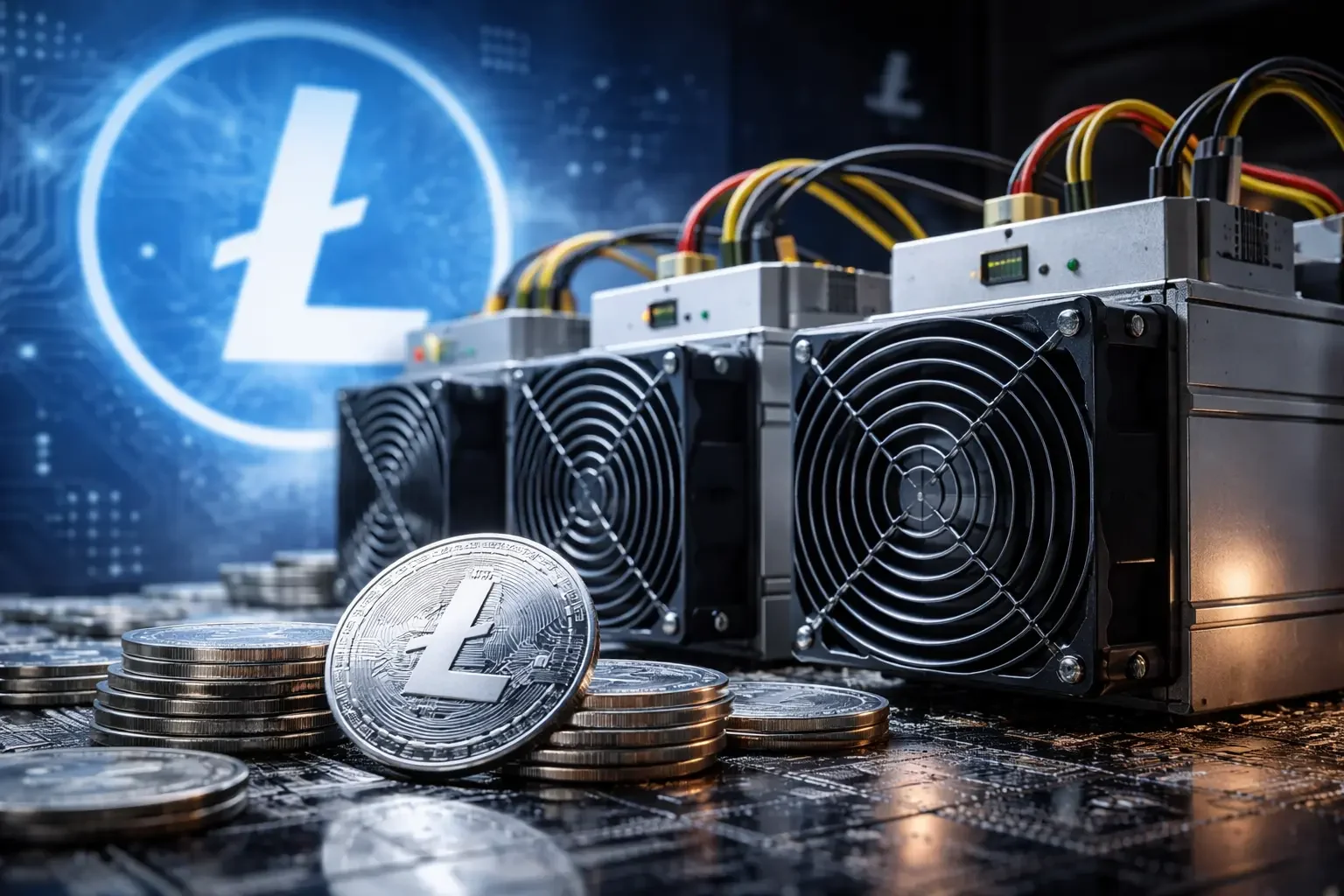
Litecoin remains one of the longest running and most actively mined cryptocurrencies in the Proof of Work ecosystem. Designed as a faster and more lightweight alternative to Bitcoin, Litecoin introduced key technical differences that continue to shape how mining works today.
Unlike newer networks that moved away from mining, Litecoin still relies on Proof of Work and the Scrypt algorithm, making it accessible through specialized ASIC miners rather than general purpose hardware. Over time, Litecoin mining has evolved into a highly optimized process, often combined with merged mining alongside Dogecoin, which allows miners to earn rewards from both networks simultaneously.
How Does Litecoin Mining Work?
Litecoin mining is the process through which new LTC coins are created and transactions are secured on the network. It is based on Proof of Work (PoW), meaning miners compete to solve cryptographic puzzles using computational power. The first miner to solve a block is rewarded with newly issued Litecoin plus transaction fees.
Unlike Bitcoin, which uses the SHA-256 algorithm, Litecoin relies on the Scrypt algorithm. Scrypt was originally designed to be more memory intensive, making early Litecoin mining accessible to a wider range of hardware. Over time, however, mining has become highly specialized, and today Litecoin is mined almost exclusively with Scrypt ASIC miners.
When miners run their hardware, they repeatedly perform calculations to find a valid block hash. Once a block is confirmed, it is added to the blockchain, and the network adjusts mining difficulty to keep block times stable approximately every 2.5 minutes, which is faster than Bitcoin. This faster block generation allows for quicker transaction confirmations.
In practice, most best Litecoin miners participate in mining pools rather than mining solo. Pools combine the hashrate of many miners, providing more consistent payouts that are distributed proportionally based on contributed computing power. This approach reduces variance and makes rewards more predictable, especially for small and mid scale miners.
How Do You Mine Litecoin?

Mining Litecoin involves a series of practical steps that connect hardware, software, and the Litecoin network. While the process itself is straightforward, success depends on choosing the right setup and operating it efficiently.
The first step is selecting Scrypt compatible mining hardware. Today, Litecoin mining is performed almost entirely with ASIC miners designed for the Scrypt algorithm. GPUs and CPUs are no longer competitive due to lower efficiency and higher operating costs.
Once hardware is selected, miners typically join a Litecoin mining pool. Solo mining is technically possible but highly unpredictable, as block discovery depends on chance. Mining pools aggregate hashrate from many participants and distribute rewards based on each miner’s contribution, providing steadier and more reliable payouts.
After joining a pool, miners must configure their miner with pool and wallet details. This includes setting the pool address, worker credentials, and a Litecoin wallet address where rewards will be paid. Proper configuration ensures accurate tracking and timely payouts.
Finally, ongoing monitoring and maintenance are essential. Miners should track hashrate performance, power consumption, temperature, and uptime. Because Litecoin mining runs continuously, stable electricity, proper cooling, and consistent connectivity play a major role in long term efficiency and profitability.
Litecoin Mining vs Bitcoin Mining
While both Litecoin and Bitcoin rely on Proof of Work, their mining ecosystems differ significantly in terms of algorithms, hardware requirements, and competitive dynamics.
Algorithm differences
Bitcoin uses the SHA-256 algorithm, which is optimized for raw computational power and favors highly specialized ASIC miners. Litecoin, on the other hand, uses the Scrypt algorithm, which is more memory intensive and designed to support faster block times. This difference directly affects the type of hardware used and how mining operations are structured. For a more complete understanding, you can read our in-depth article 👉 Which Mining Algorithm Is Most Profitable?.
Hardware cost comparison
Bitcoin mining hardware tends to be more expensive and power hungry, often requiring industrial grade infrastructure to remain competitive. Litecoin mining hardware is generally more accessible, with a wider range of Scrypt ASICs available for both home and professional setups. While costs can still be significant, entry barriers are typically lower than in Bitcoin mining.
Risk and competition levels
Bitcoin mining is extremely competitive, with thin margins and high sensitivity to electricity pricing. Litecoin mining faces less intense competition, offering more flexibility for small and mid scale miners. However, it is still subject to market cycles, difficulty adjustments, and hardware efficiency pressures.
Common Litecoin Mining Mistakes
Many new miners underestimate the practical challenges of Litecoin mining. Avoiding common mistakes can significantly improve long term results.
Overpaying for hardware
Buying miners during periods of high demand or market hype can lead to poor returns. Hardware prices fluctuate, and overpaying can extend break even timelines beyond realistic expectations.
Ignoring electricity costs
Electricity is one of the largest ongoing expenses in mining. Even efficient hardware can become unprofitable if power costs are too high. Calculating total operating costs before investing is essential.
Underestimating noise and heat
Scrypt ASIC miners generate significant heat and noise. Without proper ventilation and cooling, performance can degrade and hardware lifespan may be reduced. Planning for environmental factors is just as important as selecting the miner itself.
Frequently Asked Questions (FAQ)
Is Litecoin mining profitable?
Litecoin mining can be profitable under the right conditions. Profitability depends mainly on electricity cost, hardware efficiency, and network difficulty rather than the price of LTC alone.
How long would it take to mine 1 Litecoin?
There is no fixed time to mine 1 Litecoin. The timeframe depends on your miner’s hashrate, the total network difficulty, and whether you mine solo or in a pool. Most miners earn fractional rewards over time through pools.
Is Bitcoin mining legal?
Bitcoin mining is legal in many countries, but regulations vary by region. Miners should always check local laws, electricity regulations, and tax requirements before starting a mining operation.